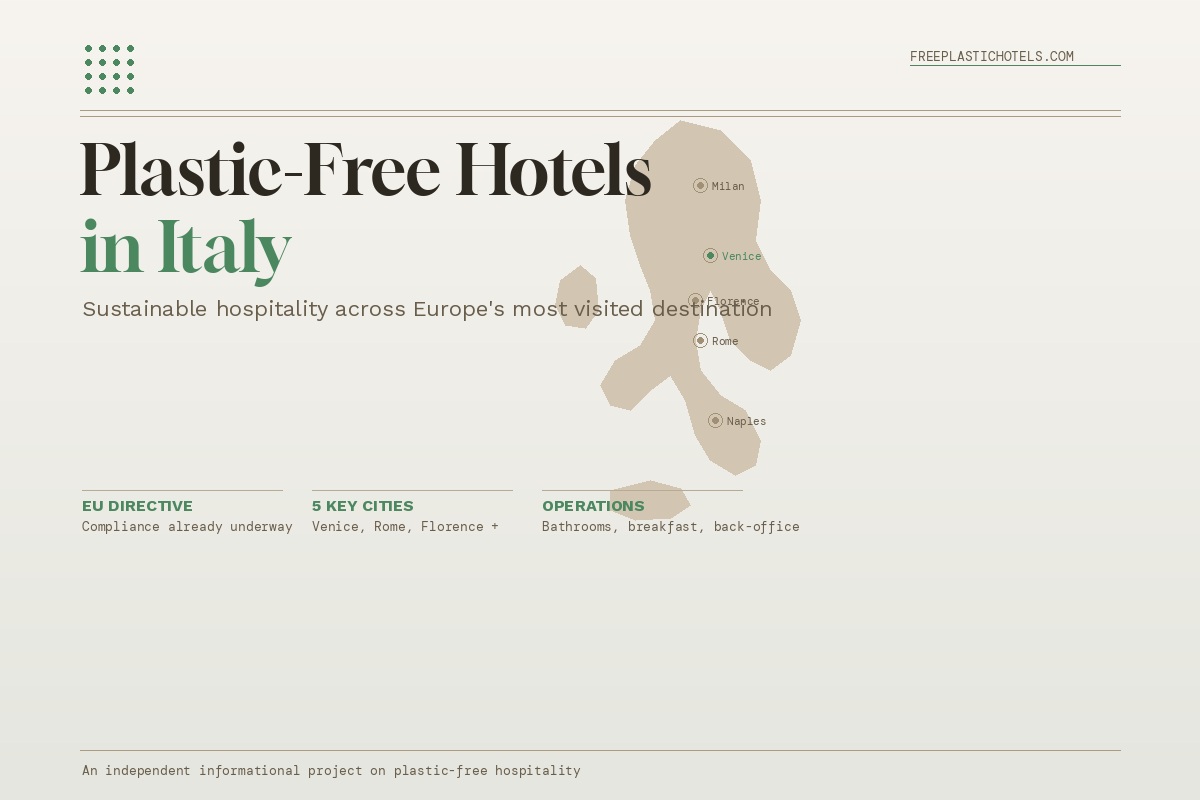
Plastic-free hotels in Italy are part of a growing shift toward responsible hospitality across one of Europe’s most visited and environmentally diverse destinations.
Plastic-Free Hotels in Italy: Reducing Single-Use Plastic Across One of Europe’s Most Visited Destinations
Italy receives tens of millions of tourists every year. Its cities, coastlines, and rural landscapes
are among the most visited in the world — and among the most vulnerable to the environmental pressure
that mass tourism brings. For hotels operating across this country, reducing single-use plastic is
no longer an optional gesture. It is an operational standard that increasingly defines how guests
perceive quality, care, and professionalism. This page explores what plastic-free hospitality
looks like across Italy, with a focus on the cities and contexts where it matters most.
Why Italy Is a Particularly Important Context
Italy’s tourism infrastructure spans a vast range of property types — from boutique rural agriturismi
to large urban hotels in Rome, Milan, Florence, and Venice.
Each context presents different challenges for plastic reduction, but the underlying pressure is the same:
guests are more environmentally aware than they were a decade ago,
regulations around single-use plastics have tightened across the European Union,
and waste management in historic city centers is increasingly strained.
Hotels that move early on plastic reduction gain a practical advantage —
lower waste costs, stronger guest perception, and readiness for incoming compliance requirements.
The EU Directive and What It Means for Italian Hotels
The European Union’s Single-Use Plastics Directive has already eliminated many common plastic items
from the Italian market — cotton buds, cutlery, plates, straws, and stirrers made of plastic
are no longer legally available for commercial use.
For hotels, this means that compliance is not a future consideration — it is already underway.
Properties that have not yet adapted their bathroom amenities, breakfast service,
and food and beverage operations are operating with materials that are increasingly
difficult to source legally and that expose the property to reputational and regulatory risk.
High-Pressure Destinations: Where Plastic Reduction Matters Most
Across Italy, certain destinations face disproportionate environmental pressure from tourism.
These are the contexts where plastic-free hotel operations have the most direct impact:
- Venice: a lagoon city where waste cannot be collected by truck and where
plastic scattered by water and wind becomes an immediate environmental threat.
For a detailed look at hospitality standards in Venice, see our page on
plastic-free hotels in Venice and the broader
hotel landscape on Hotels in Venice. - Cinque Terre and the Ligurian coast: steep, car-free villages with limited
waste infrastructure and fragile coastal ecosystems. - The Amalfi Coast: narrow roads, sea exposure, and high tourist density
make conventional waste management difficult and plastic pollution highly visible. - Rome and Florence historic centers: dense urban cores where waste
collection logistics are complex and where tourists generate large volumes of single-use plastic daily. - Lake Garda and the Italian lakes: freshwater ecosystems particularly
sensitive to plastic contamination from shoreline hotels and restaurants.
What Plastic-Free Looks Like in Practice Across Italian Hotels
For plastic-free hotels Italy-wide, the most common and effective changes follow a consistent pattern:
- Bathrooms: refillable wall-mounted dispensers replacing individual miniature bottles
of shampoo, conditioner, and shower gel. This single change eliminates hundreds of plastic units
per room per year and is now expected in higher-category properties. - Breakfast: ceramic containers, glass pitchers, and bulk servings replacing
individually wrapped plastic portions of butter, jam, honey, and juice. - Water: glass carafes or filtered water stations replacing single-use plastic
bottles in guest rooms and public areas. - Amenities on request: offering items like shower caps, cotton pads,
and plastic-wrapped accessories only when guests ask, rather than placing them automatically in every room. - Back-office and deliveries: working with local suppliers to reduce plastic
packaging on incoming goods, consolidating orders, and establishing internal guidelines
for housekeeping and kitchen teams.
Italian Travelers and International Guests: Different Expectations
Italian domestic travelers and international guests approaching plastic-free hotels in Italy
tend to respond differently to sustainability initiatives.
International guests — particularly from Northern Europe, the UK, and North America —
often arrive with stronger expectations around environmental responsibility
and are more likely to notice and positively evaluate plastic-free choices.
Italian domestic travelers are increasingly aware but may be more sensitive to
perceived quality reductions if changes are not communicated clearly.
In both cases, the principle is the same: present plastic-free choices as a standard,
not as an inconvenience, and communicate them without moral pressure.
Certifications and Claims: What to Trust
The Italian hospitality market has seen a rise in eco-labels, green certifications, and sustainability claims.
Not all of them are equally rigorous. When evaluating a hotel’s plastic-free credentials,
concrete operational details are more reliable than general claims.
A property that specifies the use of refillable dispensers, glass water bottles,
and bulk breakfast servings is more credible than one that simply describes itself as
“eco-friendly” or “sustainable” without operational specifics.
Third-party certifications such as the EU Ecolabel or Green Key provide structured verification,
but are not the only meaningful signal — many genuinely plastic-conscious properties
operate without formal certification.
Starting Small: A Realistic Path for Italian Properties
For hotels that are beginning the transition toward plastic-free operations,
the most effective approach is incremental. Starting with the highest-visibility,
lowest-risk areas produces results quickly and builds internal confidence for broader changes.
A practical sequence for most Italian properties:
- Replace bathroom miniatures with refillable dispensers.
- Remove single-use plastic from breakfast service.
- Replace plastic water bottles in rooms with glass carafes or filtered water stations.
- Shift amenities to on-request only.
- Review supplier packaging and consolidate deliveries.
For a step-by-step overview of the full process, see our guide on
how hotels can reduce single-use plastic.